

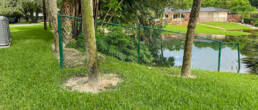
Chain link is the workhorse of commercial fencing in Florida. It is strong, it covers long distances, and it holds up well in heat and humidity. On its own, though, it hides nothing. Privacy slats change that, turning an open fence into a screen for storage yards, equipment areas, and the back side of a business.
What most owners don’t consider until after a storm is what slats do to the fence in high wind. In this guide, we explain what slats are, when a chain link fence with privacy slats makes sense, which other privacy options are worth comparing, and how screening changes wind load. If you are planning a new perimeter, our commercial fence installation team can design it with screening in mind from day one.
What Are Chain Link Privacy Slats?
Chain link privacy slats are thin strips, usually vinyl or polyethylene, that weave vertically or diagonally through the diamond mesh of a chain link fence. Once installed, they fill most of the open space in the fabric and block the view through it. Slats come in a range of colors, so they can blend with landscaping or match a building. Green, black, brown, and beige are the most common choices on commercial properties. Slats are usually sold to fit a specific fence height and mesh size, so the fabric on your fence decides which products will work. They can go in at the time of installation or be added to a fence later.
Common Slat Styles
- Standard slats: Flat strips that slide into the mesh, offering partial to high screening depending on the design.
- Winged slats: Slats with small fins that fill more of the gaps between strips for added privacy.
- Hedge-style slats: Textured slats that look like a trimmed hedge from a distance, often used where appearance matters.
- Locking or channel systems: A top or bottom channel that holds the slats in place so they are less likely to work loose in wind.
Privacy Percentage and Wind
Manufacturers usually describe their slats by an approximate privacy percentage. The higher the privacy, the less you can see through the fence, and the more wind the fence catches. That tradeoff runs through every decision in this guide. Chain link is only one of several fence types used on commercial sites, and our guide to the 7 types of commercial fencing shows how it compares with the others.
When a Chain Link Fence With Privacy Slats Makes Sense on Florida Commercial Sites
Slats are a good fit when a property already needs the security and durability of chain link but also wants to hide what is behind it. Storage yards and outdoor inventory are the most common example, since many owners would rather keep equipment, materials, and stock out of view from the street. Contractors, utilities, and fleet operators use screened chain link around equipment and vehicle areas for the same reason. Screening also makes a yard less of a target, since people passing by can’t see what is stored inside. For many owners, that alone justifies the added cost of slats over open mesh.
Behind retail buildings and restaurants, slats screen loading docks, trash collection, and service entrances from customers and neighbors. They also hide mechanical equipment such as generators and HVAC units, and they work along property lines between businesses where a neighbor’s view needs to be blocked. On sites where security comes first, slats can be added to a heavier fence line, and our perimeter security fencing page explains how screened sections fit into a secured perimeter.
Because slats can go into new or existing chain link, they are also a practical way to screen a fence that is already standing. The catch is that the existing fence has to be able to carry the extra wind, which is covered below. Across Broward and Palm Beach counties, our Fort Lauderdale fence company office often reviews existing fence lines before slats are added, so the posts and footings are checked first.
Chain Link Fence Privacy Options Beyond Slats
Slats are the best-known way to add privacy to chain link, but they are not the only one. Each option trades screening against wind load and appearance in a slightly different way.
Wind Screen
Wind screen is a knitted or woven fabric attached to the face of the fence. It screens the view while letting some air through, and because it is fastened with ties, it can be taken down ahead of a hurricane. Many products can also carry printed signage or branding, which is useful along busy roads and construction-adjacent frontages.
Lower-Privacy Slats
Slat styles with more open space trade some screening for less wind load. They suit sites that need to soften the view rather than block it completely, such as yards where staff still need to see the street or gates.
A Solid Privacy Fence
Vinyl, wood, or composite can replace chain link where full screening and a finished look matter. A solid fence may fit better when it faces customers or a main road, when complete visual privacy is required, or when noise reduction matters, since slats do little to block sound.
What Most Owners Choose
We install privacy slats by request. In practice, most owners whose main goal is privacy end up choosing a vinyl fence or, at minimum, a wind screen on the chain link. Slats make the most sense when the fence is chain link for security reasons first and screening is its second job. Many communities use the same approach, and our HOA fencing projects often pair finished privacy sections with chain link around maintenance areas.
How Privacy Slats Change Wind Load on a Florida Chain Link Fence
Plain chain link lets most wind pass through the open mesh. Fill that mesh with slats, and the fence behaves more like a solid wall, catching far more wind. That extra surface area puts more stress on the whole fence system during a storm. Posts carry more load, especially at corners and gate openings. Footings have to hold more, because the fence pushes harder against the ground in high wind. The fabric and ties take more strain, which can pull the mesh away from the posts.
If you are adding slats, plan the fence for that extra load from the start. That can mean heavier posts, closer post spacing, deeper footings, or a heavier fabric gauge. An older fence that was never designed for slats has posts and footings sized for open mesh, so screening it adds load the original design didn’t account for. Some owners choose slat styles with more open space to let wind through, while others choose wind screen and take it down when a hurricane is forecast. Either way, it is a decision to make during design.
Erick Gomez, who leads our team, lists wind load on solid and screened fences as one of the main causes of storm failure, along with shallow posts, saturated ground, and undersized materials and hardware. We are a Certified Hurricane Relief & Disaster Contractor, with post-storm fence repair in Pine Island, Upper Captiva Island, and Fort Myers, both before and since Hurricane Ian (2022), led from our Pine Island office in Bokeelia. For the full list of failure causes, read our guide to the best fence for hurricanes.
Maintaining Privacy Slats Through Florida Storm Season
Privacy slats need very little upkeep, but a few regular checks help them and the fence behind them last longer in Florida weather.
Most of these checks take only a few minutes and can be added to the property team’s regular walk of the site.
Routine Checks
- Look for slats that have slipped or worked loose, especially after a stretch of high winds.
- Watch for fading in direct sun, and replace slats in sections when color or strength starts to go.
- Inspect the ties and tension wire where slats meet the posts, since that is where the extra load concentrates.
- Clear vines, landscaping, and debris that build up against the fence, since they add weight and trap moisture.
- Look for rust on posts, rails, and fittings, particularly on properties close to salt water.
Before and After a Storm
- If you use wind screen, plan who will take it down and where it will be stored once a hurricane is forecast.
- Walk the fence line after a storm and look for leaning posts, which show up faster on screened fences.
- Check gate openings and corners first, since those posts carry the most force.
- Remove broken slats and storm debris caught in the mesh before they tear the fabric further.
If a storm does damage a screened fence, our commercial and post-storm fence repair team handles removal, reinstallation, and replacement, and documents the damage for your insurance claim. That includes fences another company installed, so you don’t need to track down the original contractor after a storm. If the damage shows the fence was undersized for its screening, we can plan the replacement for the load it actually carries.
Planning Checklist for a Screened Chain Link Fence
Start with three questions: what needs to be hidden, how much wind the site gets, and whether the fence is new or already standing. Those answers decide the slat style, or whether slats are the right option at all. Before you request proposals, run through this short list with your team:
- Which areas need full screening, and which only need the view softened?
- Will slats, wind screen, or a solid privacy fence best match your goals?
- Has the post size, spacing, and footing depth been planned for the added wind load?
- If the fence already exists, has someone checked whether it can carry slats?
- Who will remove wind screen before a hurricane, if you choose it?
- Do landlord, association, or city rules limit color, height, or screening?
- Which slat color will blend best with your building, landscaping, and neighbors?
- Do gates and openings need matching screening so the fence line looks consistent?
Request a Quote for a Screened Chain Link Fence
Whether you are planning a new screened fence or adding slats to one that is already standing, we can help you choose a screening option that fits your site and holds up to Florida wind. Our team will walk the property, check posts and footings, and put materials, layout, and a timeline in writing. Our in-house permit runner handles the permit on every project that requires one, and every project includes a 1-year warranty on labor and materials. Estimates are free, and the site visit is included. Request a quote and the office that serves your area will follow up to schedule a site visit.
Ready to Plan Your Fence Project?
Whether you’re securing a commercial property, updating a community perimeter, or adding a new fence at home, our team can take your project from planning to installation. We handle a permit pulled on every project that requires one. Every project includes a 1-year warranty on labor and materials. Warranties can be extended upon agreement.
Our Fort Lauderdale and Pine Island offices serve properties across Southeast and Southwest Florida. Tell us about your property and request a quote, and the right office will follow up.
Like this article? Spread the word!
Related Posts
November 4, 2026
The Best Fence for Hurricanes Isn’t What You Think
No single material is the best fence for hurricanes. Learn why Florida fences fail in…
November 4, 2026
7 Types of Commercial Fencing
Compare 7 types of commercial fencing, which Florida properties use each, and where each…